

7 Systems Collapse When You’re Low B6
Why a single cofactor (P5P, the active form of vitamin B6) can quietly wreck your sleep, mood, detox, and energy when it runs dry.

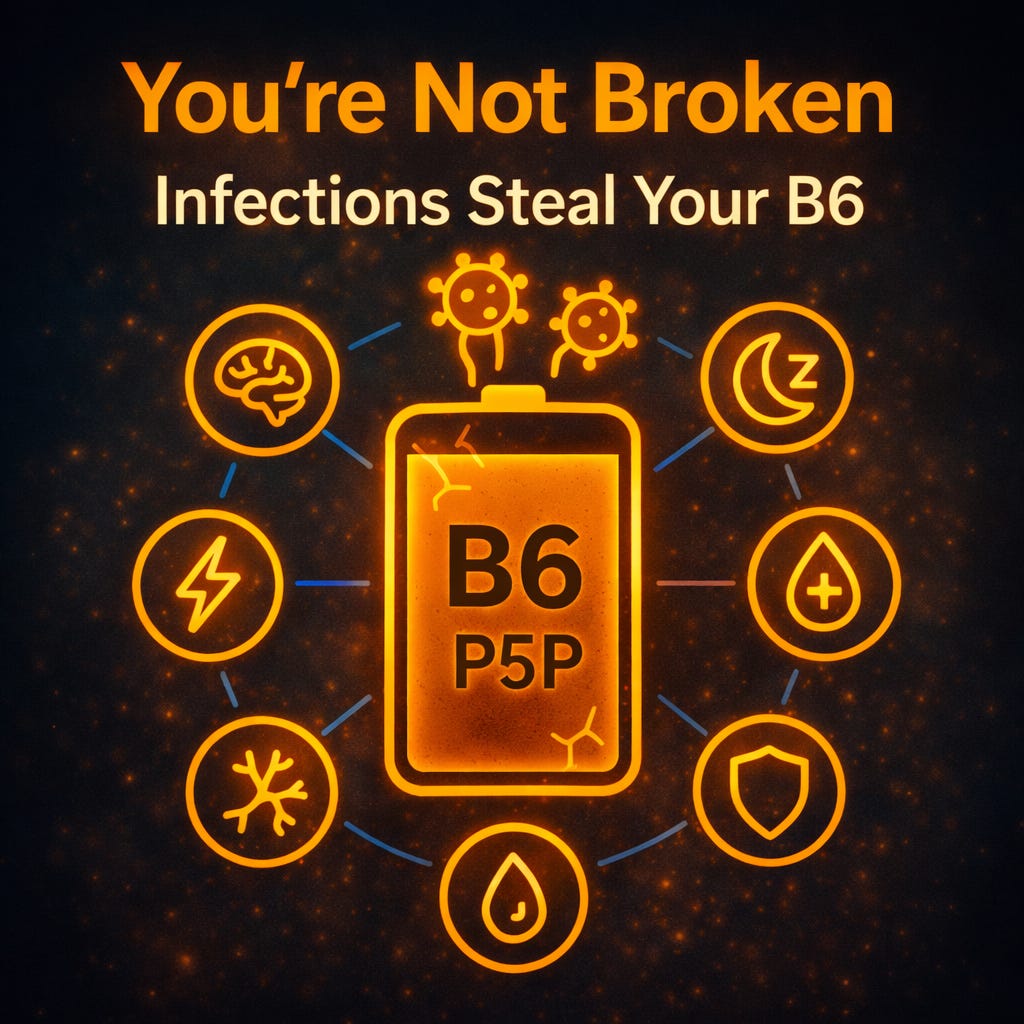
Infections can steal and break your vitamin B6.
You’ve done all the “right” things:
Cut seed oils
Tried “clean” diets
Hit the sauna, did the detoxes, bought the supplements
Maybe even ran a few fancy labs
And yet:
Your sleep is light and choppy
Your nervous system feels like a frayed wire
Histamine, oxalates, and “detox reactions” seem to stalk you
Stress hits harder than it should
You crash between meals like your body forgot how to run itself
Your oxygen delivery could even be struggling due to insufficient heme formation
You start reaching for expensive supplements:
“Maybe its CoQ10, fatty15, probiotics,” or even a dangerous supplement like iron or even the biohackers delight… methylene blue 🙃
But there’s a more basic essentialist principle that should be acknowledged first:
Do your enzymes even have the fuel they need to work?
Because there’s one nutrient that quietly powers more than a hundred enzymes touching your brain, blood, detox, hormones, and energy. This is just one nutrient and we are going to focus on just this one today.
That nutrient is P5P – the active, coenzyme form of vitamin B6.
This article is about what happens when your P5P system is running on fumes.
Recognize you have to reclaim your disbiotic terrain before B6 becomes full beneficial and functional for you.
Wait, what is P5P exactly?
Most people hear “B6” and think of a simple vitamin.
In reality:
“Vitamin B6” is a family of related molecules (pyridoxine, pyridoxal, pyridoxamine and their phosphates).
Your body has to convert the basic forms into pyridoxal-5-phosphate (P5P) – the fully activated coenzyme.
P5P is the version that actually plugs into enzymes and lets them do work.
To get there, you need:
Working liver and gut
Enough B2 (riboflavin) and magnesium
Certain enzymes (pyridoxal kinase, PNPO) to not be genetically or functionally compromised
No major drug blocks (like some anticonvulsants, TB drugs, or long-term OCP use)
So you can have:
“Normal” B6 intake on paper
“Normal” or even “ok” blood levels on a basic lab
And still be functionally low in P5P at the cell level
When that happens, seven major systems start to sag at the same time.
Let’s walk through them.
System 1 – Your Brain’s Brake Pedal (GABA, Serotonin, Dopamine, Histamine)
P5P is the quiet co-pilot behind your neurotransmitters.
A few critical P5P-dependent reactions:
Glutamate → GABA
Enzyme: glutamate decarboxylase
Role: Converts excitatory glutamate into calming GABA.
Low P5P = more wired, less “off switch.”
5-HTP → Serotonin → Melatonin
Enzyme: aromatic L-amino acid decarboxylase
Role: Final steps in making serotonin (mood, gut motility) and melatonin (sleep, repair).
Low P5P = mood instability + shallow, fragmented sleep.
DOPA → Dopamine → Noradrenaline → Adrenaline
Same enzyme family, same cofactor.
Low P5P = lower drive, focus, resilience.
Histidine → Histamine
Enzyme: histidine decarboxylase
Histamine is both a neurotransmitter and immune signal. You don’t want zero; you want regulated.
Low or chaotic P5P = histamine signaling that’s all over the map.
When this system is starving for P5P, people feel:
Anxious but tired
Overstimulated by small things
Unable to “wind down”
Sensitive to foods, smells, noises
Like they’ve lost their stable internal center
And they often blame their personality, their childhood, or “just who I am.”
Underneath, part of the story is brutally simple:
your brain chemistry is trying to run without a core cofactor.
System 2 – Homocysteine, Sulfur & Glutathione (Transsulfuration)
You’ve heard of:
Methylation
Homocysteine
Glutathione
Sulfur pathways
P5P sits right in the middle of that traffic.
Two key P5P-dependent enzymes:
CBS (cystathionine β-synthase)
Cystathionine γ-lyase
Together, they:
Move homocysteine → cystathionine → cysteine
Feed glutathione production
Regulate how your body handles sulfur, toxins, and oxidative stress
When P5P is low:
Homocysteine can trend up
Glutathione production suffers
Sulfur-handling gets janky
Heavy metals, mold toxins, and oxidative stress hit harder
This is where detox attempts go sideways.
People:
Slam NAC, glutathione, or chelators
Overwhelm a system whose basic sulfur chemistry is under-fueled
Crash, flare, or feel “poisoned” by their protocol
Then they blame the supplement, the practitioner, or their body.
A lot of the time?
Their P5P system wasn’t ready for what they asked it to do.
System 3 – Blood Sugar & Emergency Fuel (Glycogen Mobilization)
P5P also runs a key enzyme called glycogen phosphorylase.
That’s the enzyme that:
Breaks down glycogen (stored glucose)
Releases it when you need quick fuel between meals or under stress
If P5P is low:
Your ability to tap stored glycogen is compromised
You feel like a phone with a dying battery, even when you’ve “eaten enough”
Stress or fasting feel brutal instead of mildly uncomfortable
This looks like:
Shakiness between meals
Sudden irritability or anxiety when you’re hungry
Feeling like you “can’t handle” fasting or time without snacks
Needing constant stimulation or caffeine to keep going
It’s easy to interpret this as moral failure or “low willpower.”
It’s often P5P + glycogen handling showing their cracks.
System 4 – Blood, Oxygen & Detox Enzymes (Heme Synthesis)
Before your body can move oxygen or detox anything, it needs heme.
The first step of heme synthesis – the production of δ-aminolevulinic acid (ALA) – is a P5P-dependent reaction.
Heme is needed for:
Hemoglobin – carrying oxygen in your red blood cells
Cytochrome P450 enzymes – your liver’s phase I detox machinery
Mitochondrial electron transport – energy production
So low P5P can contribute to:
Anemia-like fatigue (even if iron isn’t terrible)
Lower detox enzyme capacity
Mitochondria that feel like they’re idling instead of humming
You can be stuffing in:
Iron
CoQ10
Detox supplements
…but if heme synthesis is under-powered, the entire engine underperforms.
System 5 – Oxalates, Glyoxylate & Pain
Oxalates are vicious when they pile up:
Kidney stones
Joint pain
Burning / gritty sensations
“Detox reactions” that might just be crystals irritating tissues
One of the enzymes that helps steer metabolism away from oxalate production is alanine–glyoxylate aminotransferase (AGT).
Guess what it uses? P5P.
When P5P is low:
More glyoxylate can drift toward becoming oxalate
Oxalate load rises
Every green, high-vitamin C push, or plant-heavy detox can feel like an attack
So people conclude:
“My body hates healthy foods. I can’t tolerate anything.”
When in reality, a big part of the story is:
“My oxalate-handling enzymes are running without enough P5P to keep up.”
System 6 – Nerves, Myelin & Membranes
Your nervous system is not just electricity. It’s wiring.
That wiring – myelin and neuronal membranes – depends on:
Proper sphingolipid metabolism
Adequate enzyme function during lipid remodeling and repair
Several of these steps are PLP/P5P-dependent.
Low P5P is one piece (not the only piece) behind:
Numbness, tingling, “bugs crawling” sensations
Burning feet
Strange sensory distortions
A nervous system that feels raw and uninsulated
We often jump straight to:
Metals
Mold
“Auto” immune diagnoses
Those can absolutely be real… metals, mold and “auto” immune issues can induce functional deficiencies in B6 and resolving them will spare B6 for it to do its more usual jobs.
But again, underneath all that is a simple gate:
Can your nervous system even manufacture and repair its own insulation with the cofactors it has on board?
System 7 – Immunity & Inflammation
Immune cells don’t just “fight.” They:
Clone themselves
Change shape
Release cytokines
Build antibodies
Clear damaged cells
All of that demands enzyme work.
Adequate P5P is needed for:
Normal lymphocyte function
Antibody production
Balanced cytokine signaling
Proper inflammatory tone (not too little, not too much)
When P5P is low:
You might feel like you “catch everything”
Or you swing between overreactive and underreactive
Wounds and infections seem to take longer to resolve
Again, not all of this is “just B6.”
But B6/P5P is very often not in the conversation at all, and it should be.
Why So Many People End Up in a P5P Desert
This part is not your fault.
Modern life drains B6/P5P in a bunch of ways:
Diet patterns – Ultra-processed, low-protein, plant-heavy but not nutrient-dense.
Medications – Certain TB drugs, anticonvulsants, and hormonal contraceptives can increase B6 requirements or interfere with metabolism.
Chronic stress & inflammation – Burn through B-vitamins faster.
Low B2 and magnesium – Without riboflavin and magnesium, you don’t efficiently convert plain B6 → P5P.
Genetic variations – Some people have slower PNPO or related enzymes, pushing them closer to functional deficiency.
Gut infections - Many types of infections can steal P5P from host.
So you get individuals who:
Eat “healthy” and take supplements
Still show signs of a system that looks and feels like P5P starvation
How Do You Know If This Is You?
No single symptom is diagnostic, but clusters tell a story.
Cluster A – Brain & Sleep
Anxiety or irritability
Insomnia or early waking
Strange dream patterns
Feeling overstimulated by minor stressors
Cluster B – Detox & Sensitivity
High “detox reactions” to almost everything
Sulfur and histamine sensitivity
Oxalate flares (joint pain, kidney discomfort, gritty sensations)
Cluster C – Blood & Energy
Anemia-ish fatigue despite “normal” iron
Hard time between meals, shakiness or anger when hungry
Feel like your “battery” never really charges
Cluster D – Nerves & Immune
Tingling, burning, or numbness
Frequent minor infections or slow recovery
Immune swings (hypersensitive one week, flat the next)
If you’re seeing multiple clusters and your life history matches the drain patterns above, P5P is worth taking seriously. And as you will learn, its not just about deficiency status, it s about FUNCTIONALITY.
Rebuilding a P5P System (Without Nuking Your Nerves)
This isn’t “go megadose and pray.” High, long-term B6, especially 100–200 mg+ daily has been linked with sensory neuropathy in some people.
So we treat P5P like a powerful tool, not candy.
1. Start with food
Focus on:
Animal protein – meat, fish, eggs (great B6 sources plus amino acids)
Potatoes and a few starchy plants like chickpeas
Whole, minimally processed foods instead of ultra-refined carbs
You’re not just chasing B6; you’re feeding the whole enzyme network.
Consider a low iron, animal based, reset diet that can supply bioactive compounds needed to reclaim your terrain from dysbiosis.
Carnivore In White🥛🥚You Will NEVER See RAW Milk, Eggs and a Small Steak the Same

If I recommended a diet that fewer than 10% could digest well and under 1% would even want, I’d be unserious. It must have a broader appeal and results must justify the approach.
2. Support the conversion engine
P5P doesn’t appear by magic. Support:
B2 (riboflavin) – in dairy, eggs, meat.
Magnesium – in mineral-rich water, some fruits/veg, and/or targeted supplementation
Zinc – in meat, shellfish
These are the quiet cofactors that help you actually use the B6 you eat.
3. Use supplements as levers, not crutches
Many people do well starting with low to moderate doses of P5P (for example, in a B-complex or single-nutrient form).
The goal isn’t “max dose.” The goal is restoring function without provoking neuropathy or imbalance.
If you’re already overloaded in iron, metals or mold B6 may not be right for you at this time. Work with someone to lower those and or look at the “carnivore in white” diet to lower that iron and clear infections preventing you from enjoying the benefits of B6.
4. Put it in sequence with everything else you’re doing
This is where my whole detox framework lives:
Don’t: slam chelators, sulfur, or high-intensity detox protocols into a body that can’t even move homocysteine correctly.
Do: stabilize P5P-dependent systems as part of your foundation.
Think:
“Reduce · Stabilize · Activate”
before you ever hit the “Induce · Glutathione · Chelation” stage.
Don’t let your enzymes starve.
When you zoom out, this isn’t just about a vitamin.
It’s about your brain chemistry, nervous system wiring, sulfur and glutathione traffic and ability to handle oxalates, histamine, metals, and life itself
If P5P is low, all seven systems above strain at the same time.
You feel “broken,” “cursed,” or “weak,” when in reality:
You’re under-fueled at the cofactor level.
Get that fuel back online sanely, in sequence, with respect for your biology and your protocols stop feeling like punishment and start feeling like partnership.
See how this integrates with the rest of my guides.
How P5P fits into a full B-vitamin and mineral stack
Where it intersects with heavy metal and mold detox
And how to design protocols that respect the actual order the body wants to heal in
For now, sit with this:
You are not broken.
You’re a complex system that’s been trying to run an entire city on a flickering power grid.
Fix the power.
Then watch what your “broken” systems quietly remember how to function.
This article is also a precursor to the “Glutathione Support Guide” Make sure to go through the first 3 STAGES in the “Heavy Metal & Mold Detox Guide” Before you do this one, still great to study and understand the whole process before you execute.

Heavy Metals & Mold Detox Guide V4

Welcome to - Mineral Chief Heavy Metal & Mold Detox V4 - a deep healing master guide that places practices and articles in STAGE BY STAGE easy to follow hierarchy.